
Vibely
The AI agent factory: from plain-language intent to a working swarm
For: Teams and agencies that want to deploy multi-agent AI workflows for service businesses without writing orchestration code, developers who prefer a CLI, and the company's own products (VoiceCosmos, Studio Munich) that run on its engine.
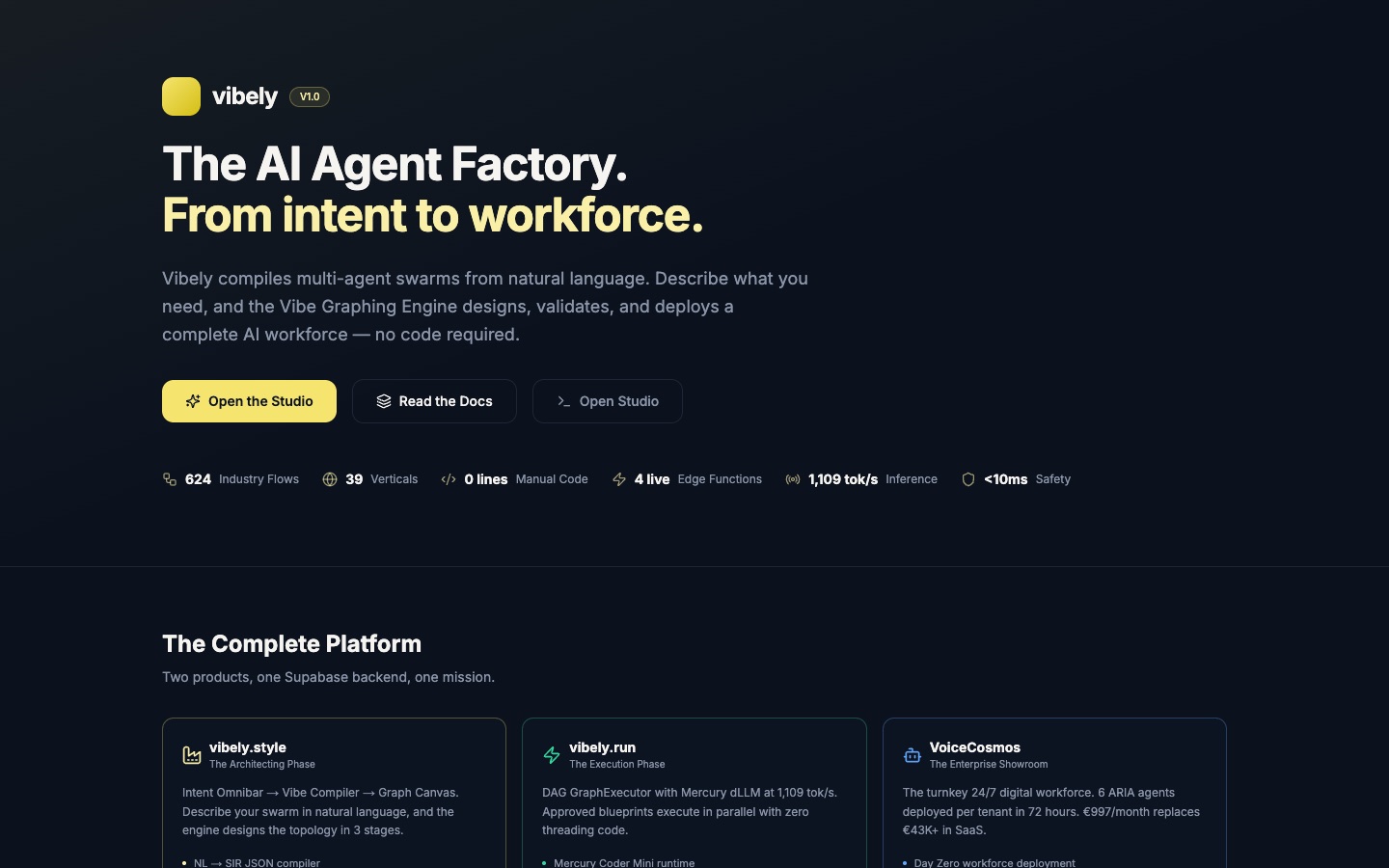
Vibely is a platform for building and running teams of AI agents without writing orchestration code. You describe an outcome in plain language, and Vibely's compiler turns it into a structured agent graph: which agents exist, what each one does, which model and tools it uses, and how work flows between them.
It has two halves. vibely.style is the design phase: an intent bar, the Vibe Compiler and a drag-and-drop graph canvas where the proposed workflow can be inspected and edited. vibely.run is the execution phase: approved blueprints run as a directed graph with parallel branches, loops and human-in-the-loop checkpoints.
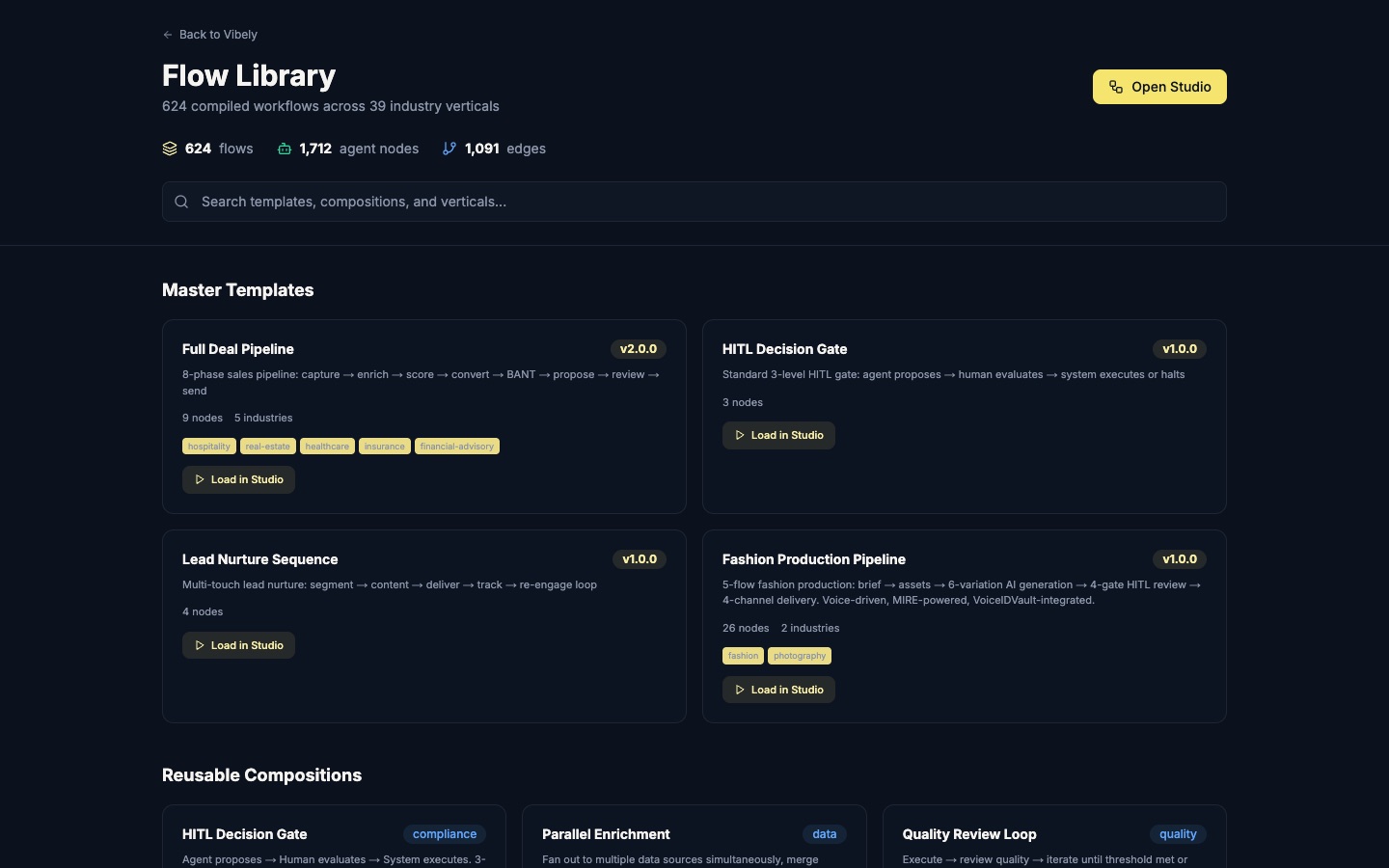
The core asset is a library of 624 pre-compiled industry workflows across 39 verticals, from hospitality and real estate to healthcare, insurance and aviation, built on reusable templates such as a full deal pipeline, lead nurturing and a three-level human approval gate.
Vibely is the workflow engine behind VoiceCosmos, the company's voice-first digital workforce for service businesses, and is also integrated with Studio Munich's catalogue production pipeline. Developers can use the same engine from the terminal through the Vibely CLI.
624
Compiled industry workflows
39
Industry verticals
1,712
Agent nodes in the Flow Library
1,109 tok/s
Runtime inference (Mercury Coder Mini)
What it does
Natural language to agent graph: a three-stage compiler turns an intent into a validated JSON blueprint (SIR) with agents, models, tools and edges
Visual Graph Canvas built on React Flow for inspecting and editing the generated topology, saved as .vibely files
DAG execution engine with nine node types, including switch nodes, parallel fork/join, loops with exit conditions and human-interaction nodes
Three human-in-the-loop levels: fully automatic, supervised (reviewed after the fact) and manual (halts until a person approves)
Flow Library of 624 compiled workflows across 39 verticals, plus reusable master templates and compositions
Safety layer: pattern-based AIDefence checks for prompt injection, jailbreaks and PII in under 10 ms, followed by an LLM critic that scores task performance, goal adherence and norm compliance
SONA learning loop that scores runs from human approvals and rejections to improve future workflows
Vibely CLI: init, dev with hot reload, lint a graph for cycles and dangling nodes, run, push to cloud and stream live traces
How we architected it
- Next.js 14
- React 18
- TypeScript
- Tailwind CSS
- React Flow (@xyflow/react, reactflow)
- Supabase
- Supabase Edge Functions
- Inception Mercury (dLLM)
- Anthropic Claude
- OpenAI-compatible APIs
- Model Context Protocol (MCP)
- Stripe
- Resend
- Commander / Chokidar (CLI)
- Vercel
- 01
Next.js 14 application (TypeScript, Tailwind CSS) on Vercel, with Supabase (Postgres, auth, edge functions) as the shared backend for vibely.style and vibely.run
- 02
Dual-model routing: an expensive build model (Claude Opus or GPT class) is used only to design graph topologies; a fast invoke model (Inception Mercury diffusion LLM via an OpenAI-compatible API, or Haiku) executes agent nodes at runtime
- 03
Compilation produces a SIR JSON blueprint that passes structural schema validation before it can run
- 04
Runtime executor walks the graph, runs independent branches in parallel and pauses at HITL gates; deterministic tool calls go through FACT edge functions and MCP context adapters
- 05
Supabase edge functions in the repo cover intent classification, BANT lead scoring, lead capture and lead enrichment
- 06
Two-layer safety: deterministic AIDefence regex checks (no LLM call) then a semantic NL Critic, before outputs reach the human approval queue
- 07
Exposes an API (/api/vibe/compile, execute, scan, patterns and related routes) consumed by VoiceCosmos and Studio Munich; Stripe and Resend handle billing and email
- 08
Separate Node CLI (commander, chokidar, ws) mirrors the web studio for terminal users

Want something built like this?
Every build runs the same five gates: spec, architect, build, review, ship. It starts with a 48-hour audit.