The Nine Foundation
Nine refusals that make trust verifiable, not asked for
For: Security architects, engineers, founders and governance or compliance practitioners who want a concrete, non-certifying standard for trustworthy digital systems; readers who want to check the company's own products against it.
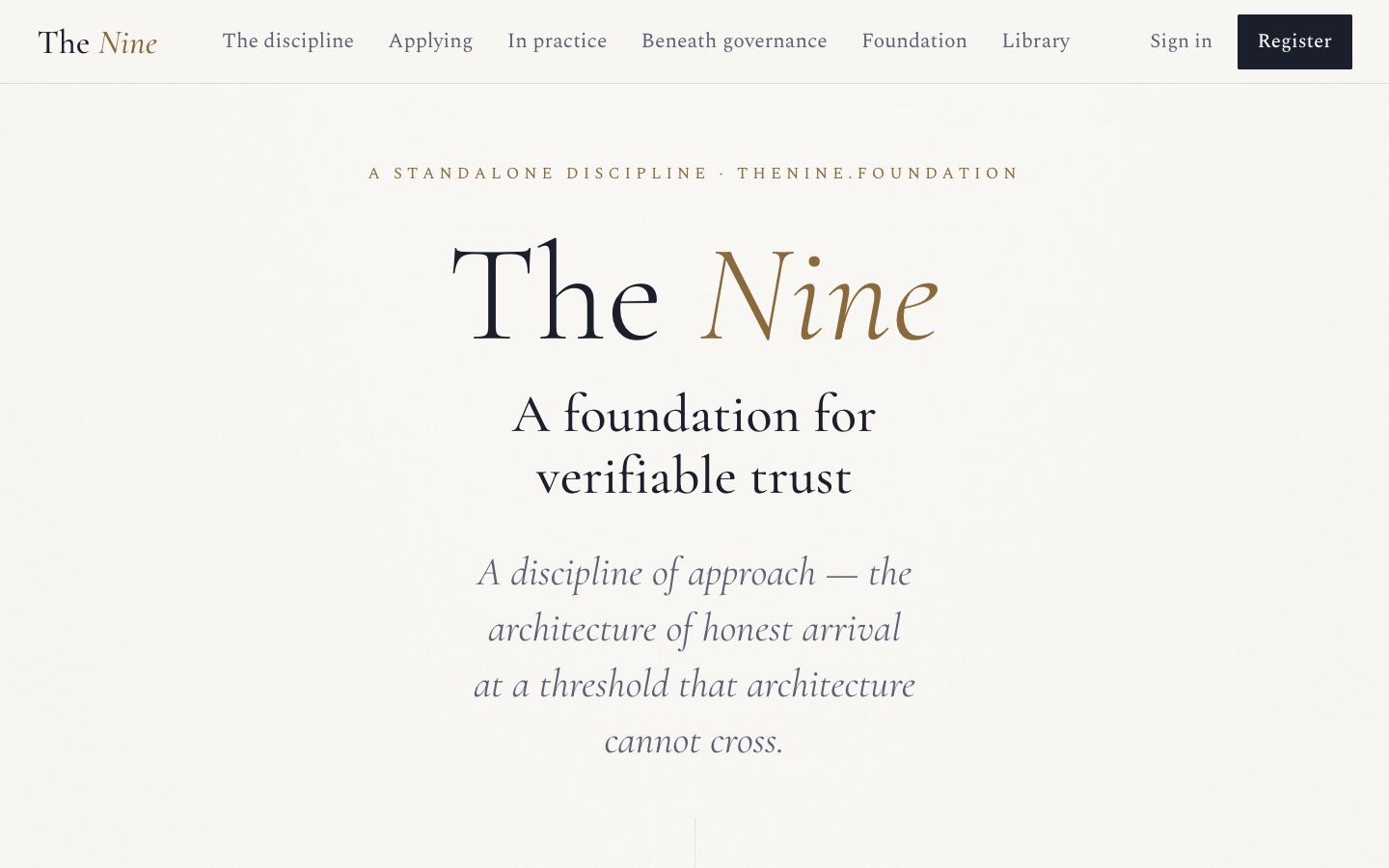
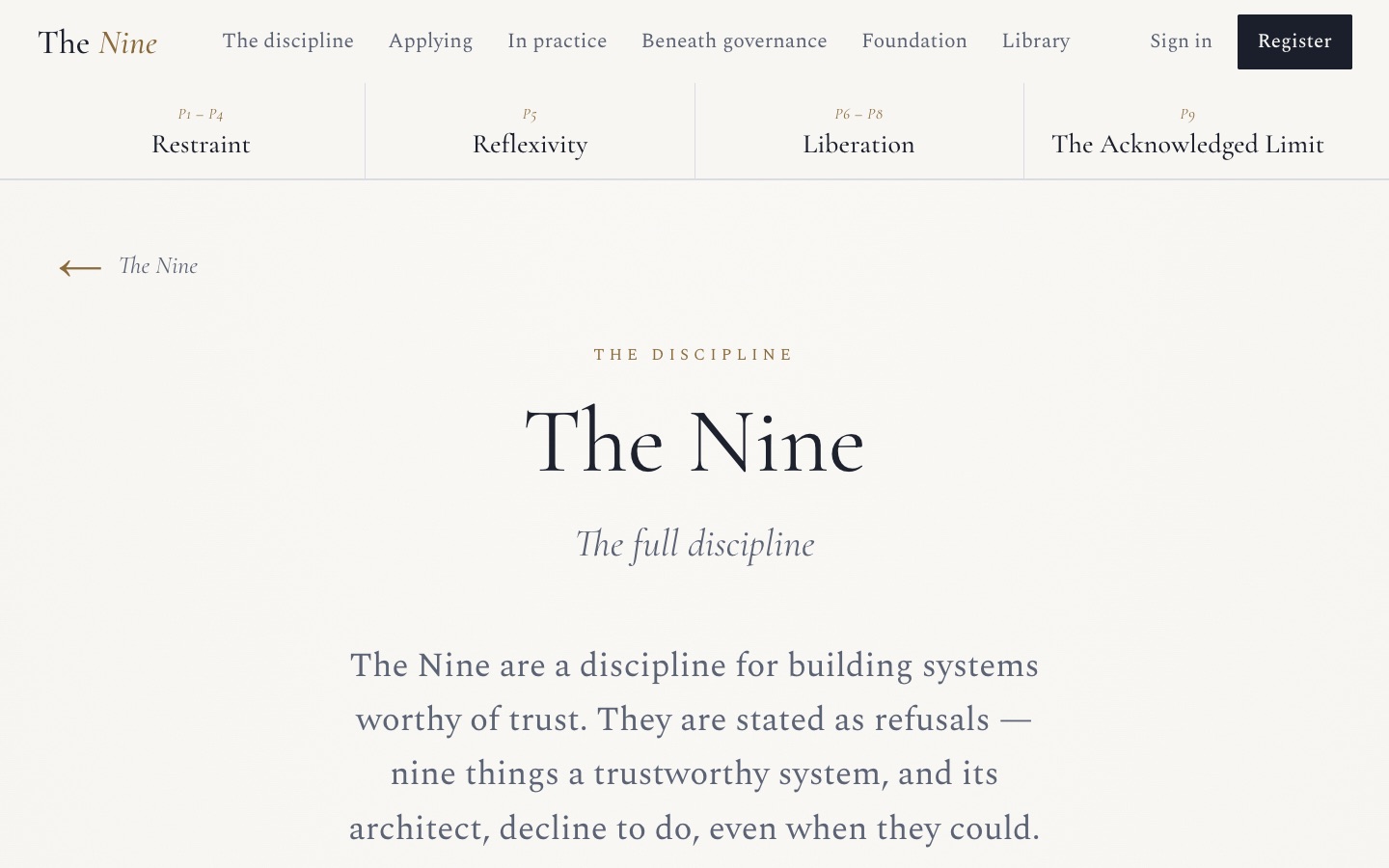
The Nine is a discipline for building digital systems that people can trust. It is stated as nine refusals: things a trustworthy system, and the person who builds it, decline to do even when they could. They are grouped into four movements: Restraint (minimise the secret, prove don't grant, architect for change, never claim more than you can verify), Reflexivity (the rule binds its keeper), Liberation (be safely endable, let entry be freely chosen, do not trap, coerce or extract) and the Acknowledged Limit (trust itself cannot be generated by the architecture).
It is deliberately not a certification or a product. It is granted by no authority, there is no badge, and anyone may keep it. It was set down by Riaan Kleynhans, its author and first keeper, and is kept first in VoiceCosmos and VoiceIDVault, where the author is bound by the rule before anyone else is asked to be.
thenine.foundation is the discipline's public home and its first keeping in software. Tier 1 is free to read with no registration: the full discipline, how to apply it, what it looks like in practice, how it sits beneath governance frameworks, and what it changes for a company. Tier 2 is a library of 26 canonical PDFs for registered readers.
It is written for security architects, engineers, founders and governance practitioners who want a concrete standard for trustworthy systems, and for anyone who wants to hold the company's own products to that standard.
9
Principles across 4 movements
26
Canonical documents in the library
9
Languages
What it does
The full discipline in plain prose: nine principles across four movements, each with its own page
Practical guidance: applying the discipline, what changes in an organisation that keeps it, where it breaks under pressure, and the rituals that keep it alive
'Beneath governance' and 'Foundation' pages that place The Nine under existing frameworks and describe what changes for a company
Gated library of 26 version-tracked PDFs with changelogs, grouped into ground, profiles, conscience and governance, perimeter, the discipline and the practice
Magic-link sign-in; downloads are logged to the reader's own account and openly disclosed
Account export and deletion at any time
Machine-translated editions in nine languages, each with a provenance banner (English, Chinese, Spanish, French, German, Japanese, Italian, Arabic with right-to-left layout, Portuguese)
How we architected it
- Next.js 16
- React 19
- TypeScript
- Supabase (Auth, Postgres, Storage)
- Cohere Aya (cohere-ai)
- react-markdown
- remark-gfm
- rehype-slug
- gray-matter
- Vercel
- 01
Next.js 16 App Router application with React 19 and TypeScript, deployed on Vercel with GitHub auto-deploy from main
- 02
Public prose lives in Markdown files (content/*.md with front matter), rendered through a shared MarkdownPage component using react-markdown, remark-gfm and rehype-slug
- 03
Translations are generated at build time by a script that calls Cohere Aya; English remains the canonical source
- 04
Supabase handles magic-link auth, profiles, documents, document versions and downloads; library PDFs sit in a private Supabase Storage bucket
- 05
Append-only audit log enforced in Postgres: UPDATE and DELETE revoked from every role including service_role, BEFORE UPDATE/DELETE triggers that reject mutation, and inserts only through SECURITY DEFINER triggers
- 06
The administrator's own actions appear in the same audit log as every reader's, in line with Principle 5
- 07
Coding agents working on the repo are bound to the discipline through AGENTS.md and CLAUDE.md; held material (counsel drafts, product-specific profiles) is kept out of the public repo and listed in MANIFEST.md
Want something built like this?
Every build runs the same five gates: spec, architect, build, review, ship. It starts with a 48-hour audit.