
Q-Intercept
Find which HPC workloads will benefit from quantum, and when
For: CIOs, HPC and research-computing leaders at large enterprises in pharma, finance and logistics who need an evidence-based view of quantum readiness before committing budget.
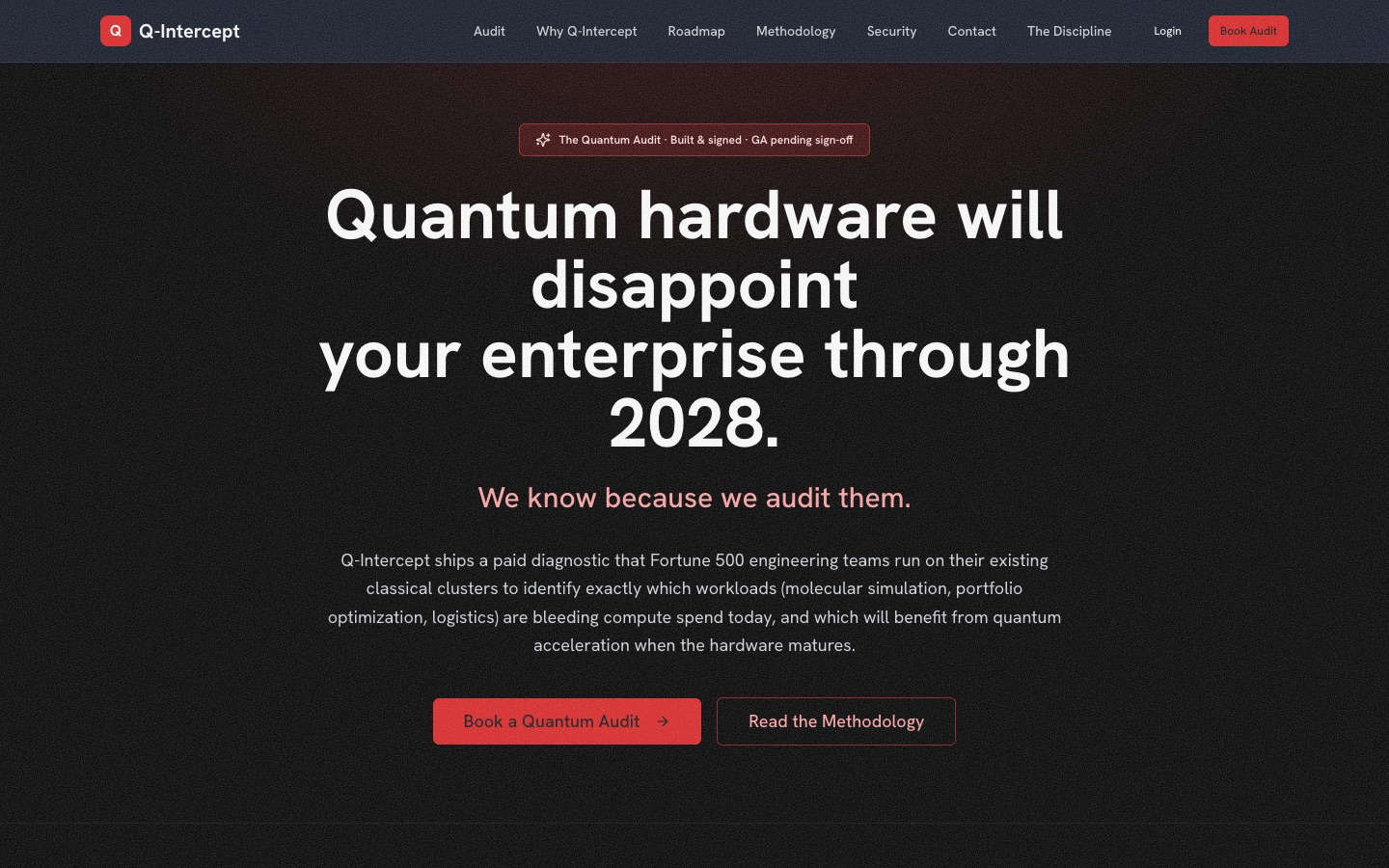
Q-Intercept sells the Quantum Audit: a diagnostic command-line tool that runs inside a customer's own HPC infrastructure, reads scheduler logs locally, and identifies which workloads, such as molecular simulation, portfolio optimisation or logistics, are costing the most compute today and which are candidates for quantum acceleration once the hardware matures.
It is aimed at engineering and infrastructure leaders at large enterprises, with a focus on pharma, finance and logistics, where quantum-advantaged problem types are well characterised. Each workload receives a Quantum Suitability Score from 0 to 100, a band, and the earliest credible hardware horizon for its archetype.
The product is deliberately conservative. Q-Intercept states up front what it will not claim: no speedup multipliers on today's hardware, no promised quantum-advantage dates, no vendor performance comparisons and no ROI projections beyond classical bottleneck cost. The scoring is rule-based and auditable, with no machine-learning black box.
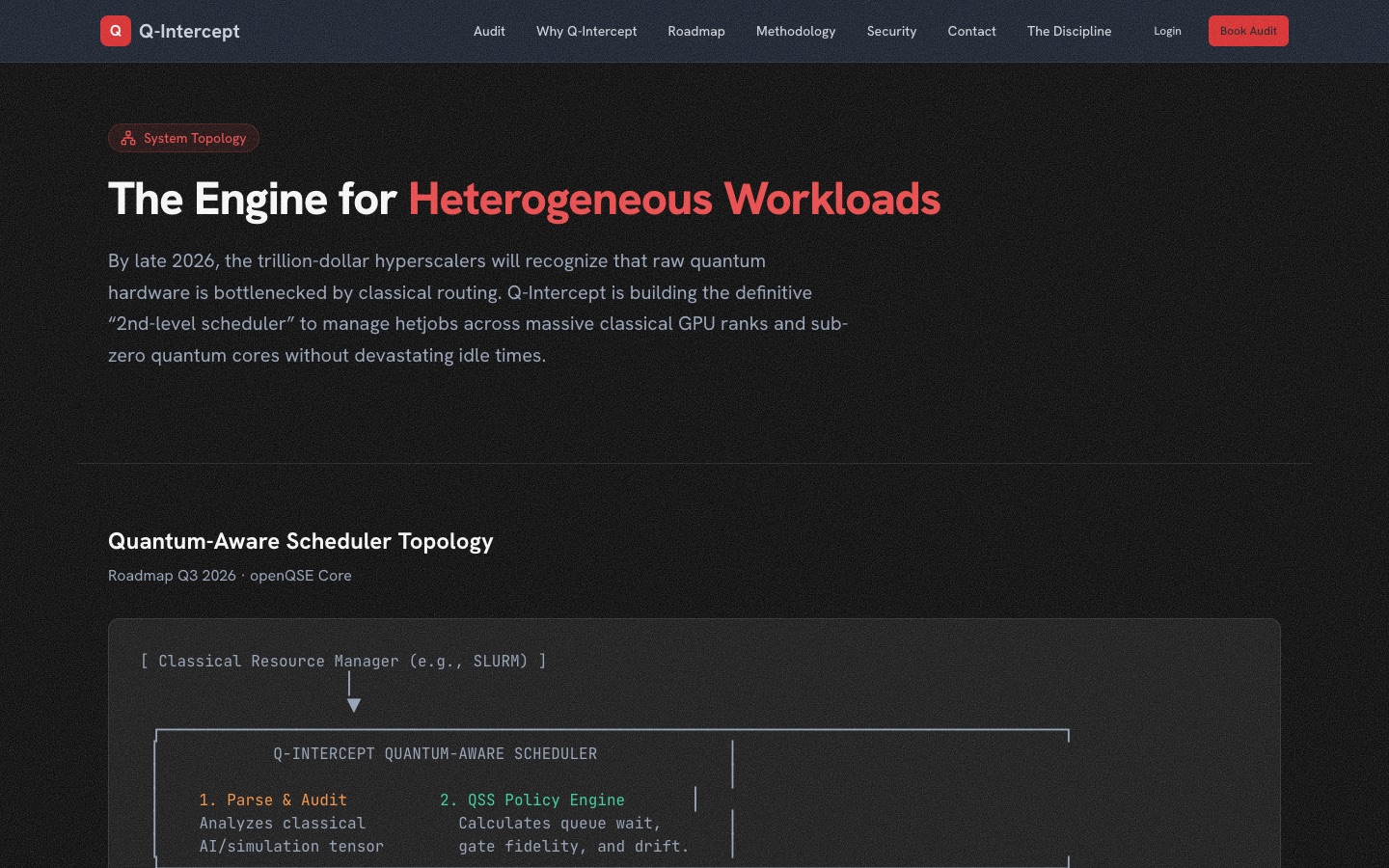
Beyond the audit, the public roadmap describes a hardware-agnostic layer for hybrid quantum-HPC computing: a Latency Index benchmark built from audit data, a quantum-aware scheduler on top of Slurm, Kubernetes and PBS Pro, and later a hardware virtualisation layer. These are roadmap items, not shipped products.
$40K
per audit engagement
2 weeks
from kickoff to board-ready report
15
quantum-advantaged workload archetypes
0–100
Quantum Suitability Score per workload
What it does
On-prem audit CLI that reads Slurm, Kubernetes (including Argo Workflows) and PBS Pro scheduler logs
Workload classification against a library of 15 quantum-advantaged archetypes
Deterministic Quantum Suitability Score (0–100) per workload from five weighted inputs
Dollar cost of each bottleneck on classical infrastructure, with queue-wait cost shown separately
Board-ready PDF with the methodology version and hash printed on every page
Sanitised manifest export only after the customer types an explicit consent token
Public methodology and a dated public roadmap with what is and is not committed
Runs air-gapped; distributed as a GPG-signed single binary
How we architected it
- Python 3.11 (standard library)
- PyInstaller
- Docker
- GnuPG
- pytest
- mypy
- ruff
- Next.js 15
- React
- TypeScript
- Supabase
- Vercel
- Resend
- 01
The audit CLI is written in Python with no runtime dependencies beyond the standard library, including the PDF writer; the release bundle's module list is checked on every build
- 02
It imports no network-capable module (enforced by an automated test) and completes a full audit with networking disabled at the kernel level
- 03
Pipeline: scheduler-log parsers produce workload signatures, an archetype classifier matches them, a deterministic QSS calculator and cost model score them, and a local PDF is generated on the head node
- 04
Determinism contract: the same logs, rates and methodology version give byte-identical scores and classifications, so reports are reproducible from inputs
- 05
Distribution as a PyInstaller single-file binary for Linux x86-64, with a Docker image on the roadmap; releases are GPG-signed and verified with published SHA-256 sums
- 06
Controls are mapped against NIST SP 800-53, ISO/IEC 27001 and SOC 2 TSC in a published security whitepaper; incident handling follows NIST SP 800-61
- 07
The marketing site and customer portal are a separate Next.js application on Vercel with Supabase, kept apart from the private CLI repository by design

Want something built like this?
Every build runs the same five gates: spec, architect, build, review, ship. It starts with a 48-hour audit.