Pod-Geni
An AI studio that listens while you record your podcast
For: Podcast hosts and creators: interview-focused shows, solo creators, beginners and established professionals who want recording, editing and publishing in one tool.
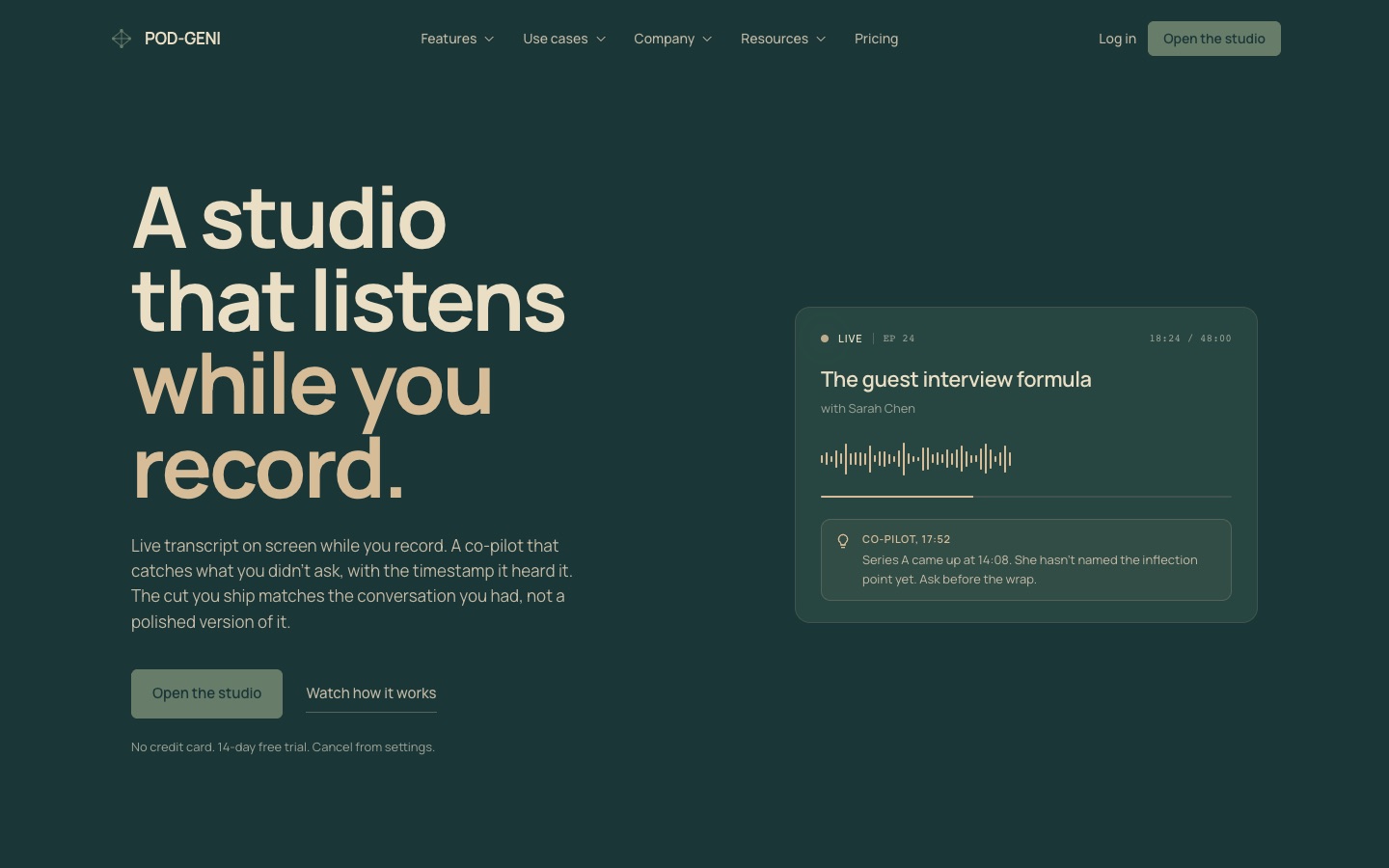
Pod-Geni is a web studio for podcasters that covers the whole episode in four steps: research, record, edit and publish. Hosts drop in URLs, PDFs, YouTube links or a NotebookLM export, and Pod-Geni reads the sources, surfaces themes and proposes questions, each tied back to the passage it came from.
During the recording a live transcript runs on screen and a co-pilot watches the conversation. When a guest mentions something worth following up, it suggests the question together with the timestamp where it heard it. Guests join by link in HD video, and each participant is recorded on a separate track.
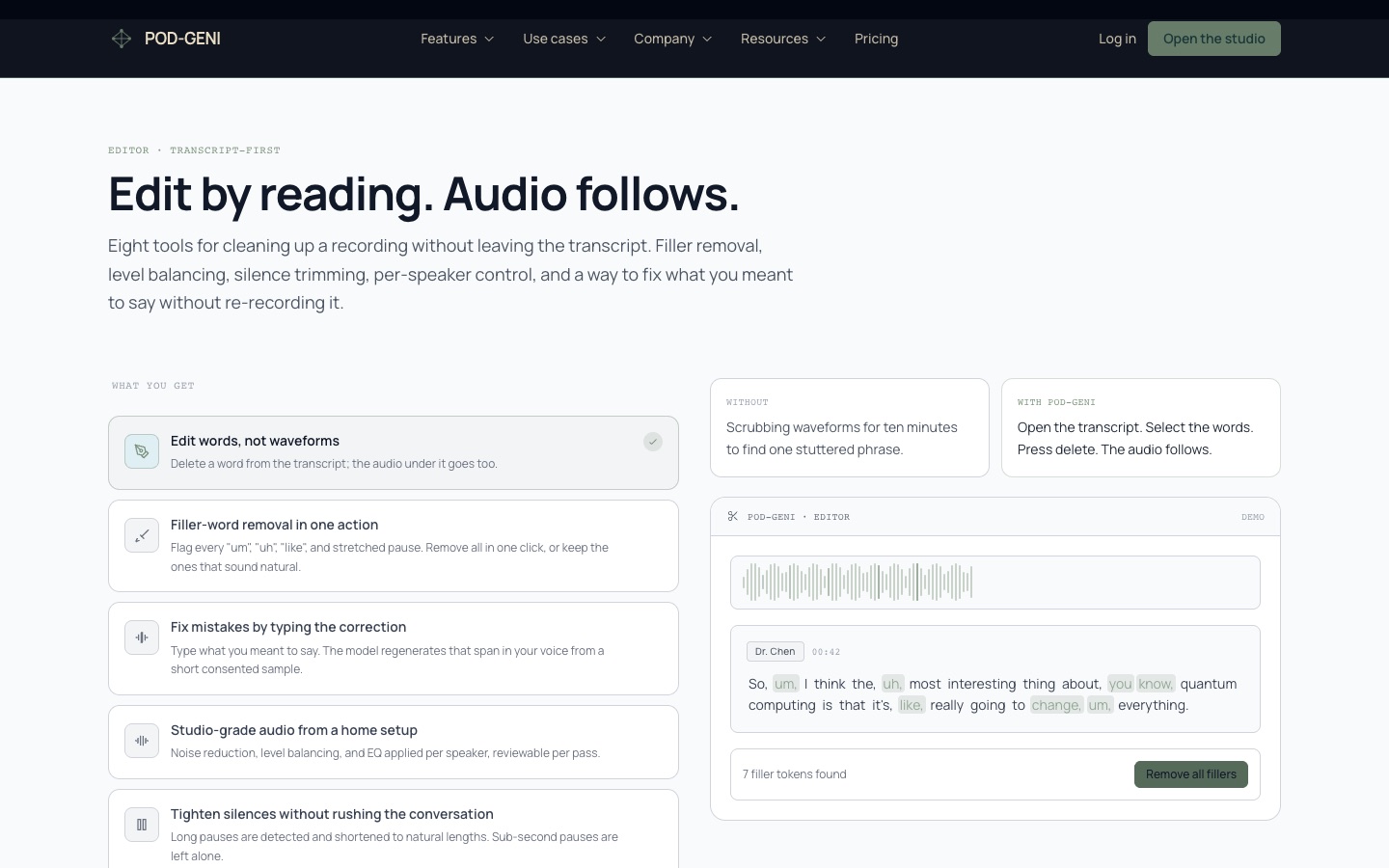
Editing is transcript-first: delete a word in the text and the audio under it goes too. Filler words, long silences and level differences are cleaned up in a few actions, and passages worth quoting are flagged for short-form clips. The site puts a typical 45-minute interview episode at around 90 minutes end to end, compared with 8 to 12 hours done by hand.
It is built for interview hosts, solo creators, beginners and established professionals. A principle across the product is that the AI shows its work: suggestions, flags and reports always point back to a transcript quote, timestamp or source document.
~90 min
Typical end-to-end time for a 45-minute interview episode (site figure, vs 8–12 hours by hand)
14 days
Free trial, no credit card
What it does
Research notebook that imports URLs, PDFs, YouTube, Google Drive and NotebookLM, and suggests questions that cite their source passage
Live transcript and AI co-pilot that suggests follow-up questions during the recording, with timestamps
Remote HD video recording over WebRTC with guests joining by link and one track per speaker
Transcript-first editor: delete words to cut audio, remove filler words in one action, tighten long silences
Per-speaker noise reduction, level balancing and EQ
Correct a misspoken phrase by typing it, regenerated in the host's voice from a short consented sample
Quote and clip detection with vertical or square captioned clip export
Publishing to RSS, Spotify, Apple and video platforms, with generated show notes and SEO metadata
How we architected it
- React 19
- Vite
- TypeScript
- Tailwind CSS
- Framer Motion
- ReactFlow
- Firebase Hosting
- Firebase Auth
- Firestore
- Cloud Storage
- Cloud Functions (Node 20)
- Google Cloud Run
- Google Gemini
- Daily.co
- Deepgram
- VoxCPM2
- FFmpeg (wasm)
- Stripe
- Sentry
- PostHog
- 01
React 19 single-page app built with Vite and TypeScript, served from Firebase Hosting with CSP and security headers
- 02
Firebase Auth, Firestore and Cloud Storage, all gated by security rules; billing fields cannot be written from the client
- 03
Cloud Functions (Node 20) act as the server-side trust boundary: Gemini proxy with rate limiting, Stripe billing and webhooks, Daily.co room and token handling, scheduled publishing and recursive GDPR account deletion
- 04
Real-time recording runs on Daily.co (WebRTC) with multi-track capture; ReactFlow drives the knowledge graph and live mind map
- 05
Google Gemini (@google/genai) for research analysis, question generation, live suggestions and post-production; no AI or payment key ships to the browser
- 06
Optional AI Guest: a separate Cloud Run worker joins the call as a headless participant on its own audio track, with a speech-to-text, Gemini and VoxCPM2 48 kHz text-to-speech loop grounded in the host's research corpus
- 07
A Cloud Run render service turns transcripts into designed vertical clips, quote cards and trailers
- 08
Voice recordings are treated as special-category personal data; Sentry and PostHog for observability

Want something built like this?
Every build runs the same five gates: spec, architect, build, review, ship. It starts with a 48-hour audit.