
FluxCore Dynamics
AI-assisted photonic chip design, from sketch to foundry file
For: Photonic and optical engineers, R&D teams at photonics, semiconductor and quantum-hardware companies, and university photonics labs (free academic tier, classroom and research-lab licences).
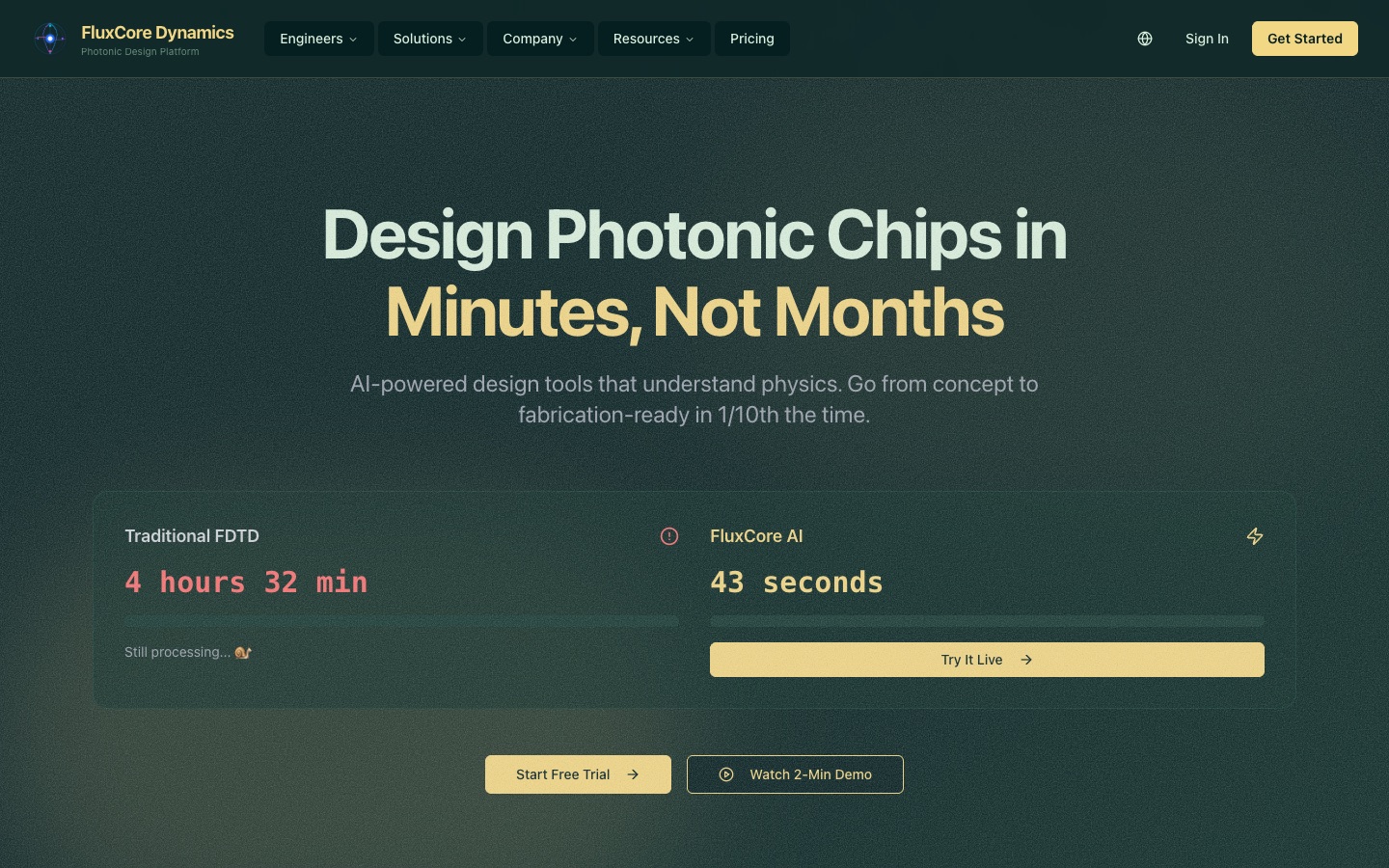
FluxCore Dynamics is a design platform for photonic chips, the light-based circuits used in data-centre interconnects, LiDAR, sensing and quantum hardware. It combines a visual circuit editor, fast performance prediction and fabrication checks in one browser-based workspace.
The problem it addresses is slow iteration. Full electromagnetic simulation (FDTD) of a single component can take hours, so design cycles stretch into months and failed fabrication runs are expensive. FluxCore gives engineers an estimate of how a waveguide, coupler or resonator will behave within about a second, so they can explore more options before committing to a full simulation or a tape-out.
It is built for photonic engineers, R&D teams at photonics and semiconductor companies, and university labs. A free Explorer tier and an academic programme sit alongside paid Professional, Team and Enterprise plans, and the enterprise offer includes on-premise deployment for IP-sensitive design data.
FluxCore Dynamics was founded in Munich in 2025 by Riaan Kleynhans. The company describes itself as building the platform and actively seeking investment.
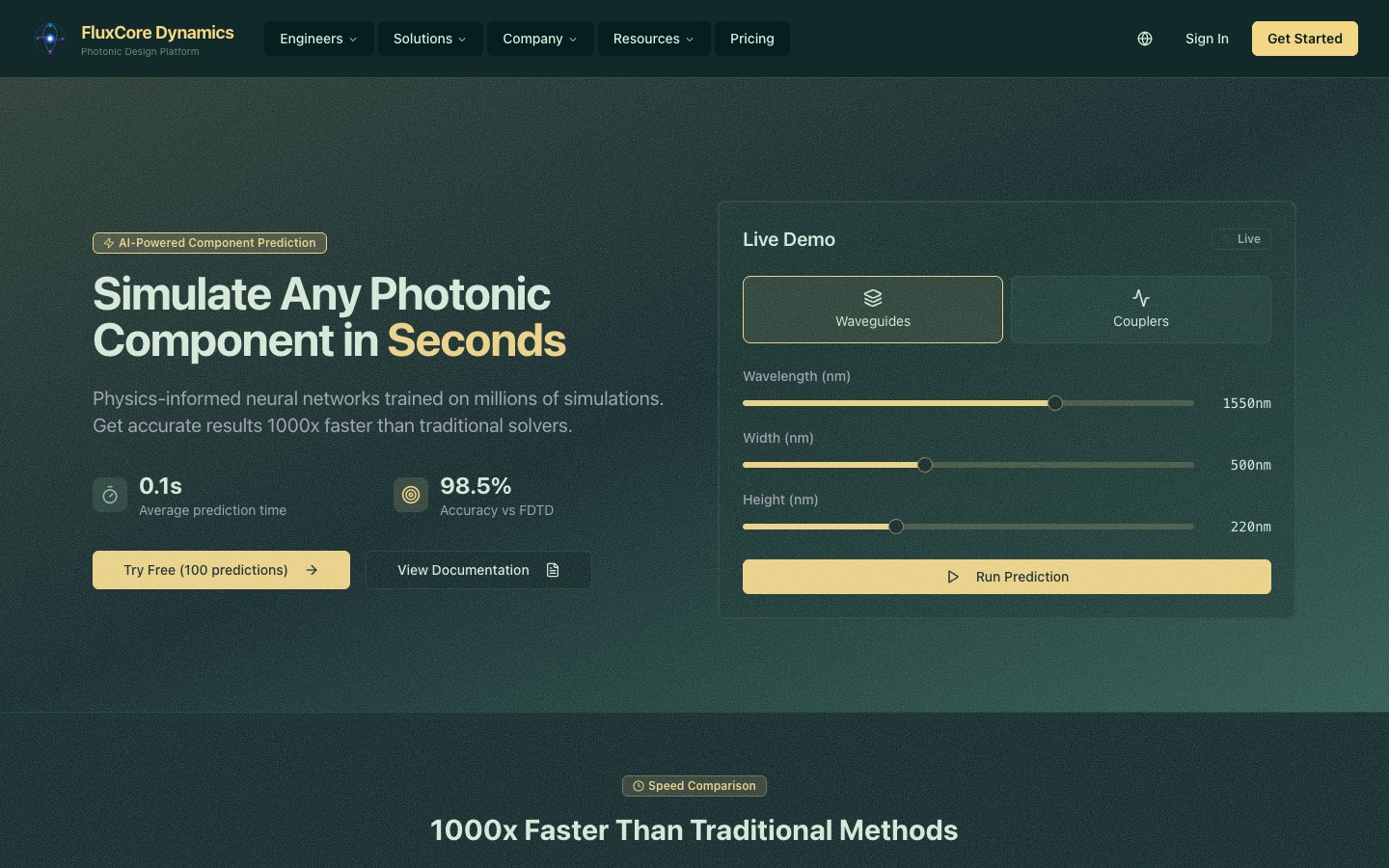
0.1s
Average prediction time (stated on site)
98.5%
Stated accuracy vs FDTD
1000x
Stated speed-up over traditional FDTD
$0
Explorer tier, 100 AI predictions a month
What it does
AI Predictor: physics-informed estimates of effective index, loss, group index and dispersion for waveguides, couplers and resonators, with S-parameters returned in under a second
Design Studio: a browser-based circuit editor with parametric components, live physics feedback, snap-to-grid, undo/redo and automatic Manhattan routing
In-browser 2D FDTD solver (Yee grid with PML boundaries) and a public validation page that benchmarks it against analytic cases
Inverse design and optimisation: topology optimisation, Bayesian parametric search, genetic (NSGA-II) and gradient (L-BFGS-B) optimisers and parameter sweeps
Fabrication Suite: design-rule checks, yield prediction, cost estimates, foundry comparison and GDSII export
Model Forge: train custom prediction models on a team's own process data and PDKs
Real-time team collaboration with version history, snapshots and restore
REST API with Python and MATLAB integration for scripted and batch predictions
How we architected it
- Next.js 15
- React
- TypeScript
- Tailwind CSS
- Radix UI
- Konva
- Three.js / React Three Fiber
- React Flow (@xyflow/react)
- Socket.IO
- Supabase
- Redis / Upstash
- Stripe
- OpenAI API
- next-intl
- Python
- FastAPI
- PyTorch
- NumPy / SciPy
- Ray
- SQLAlchemy / Alembic
- Docker
- Vitest
- Playwright
- Vercel
- 01
Next.js front end (Pages Router, TypeScript, Tailwind CSS) served from Vercel, with the circuit canvas built on Konva and 3D views on Three.js / React Three Fiber
- 02
Python FastAPI backend with route modules for prediction, optimisation, inverse design, ML training, manufacturing, quantum analysis, search and version history
- 03
Prediction combines analytical photonics models (Marcatili, Payne-Lacey, coupled-mode theory, transfer matrix) with PyTorch-based physics-informed neural network work
- 04
A TypeScript FDTD solver runs client-side for live light-propagation visualisation and powers the /validation benchmark page
- 05
Separate WebSocket server (Socket.IO) for real-time collaboration, using CRDT / operational-transform merging and snapshot-based version history
- 06
Supabase for authentication and data, Redis caching with a circuit breaker, Stripe for subscriptions with tier-based feature gating
- 07
Security middleware with XSS/SQL-injection detection, per-IP rate limiting and audit logging; Enterprise plan offers on-premise deployment
- 08
Docker and docker-compose definitions for the API and AI services; Vitest and Playwright test suites
Want something built like this?
Every build runs the same five gates: spec, architect, build, review, ship. It starts with a 48-hour audit.